
P0300 on a 2016-2018 Honda Civic (1.5T): Random Misfire? Read Every Stored Code First
 JC Landry, ASE Master TechnicianPublished Oct 13, 2026 · Updated Oct 30, 2026
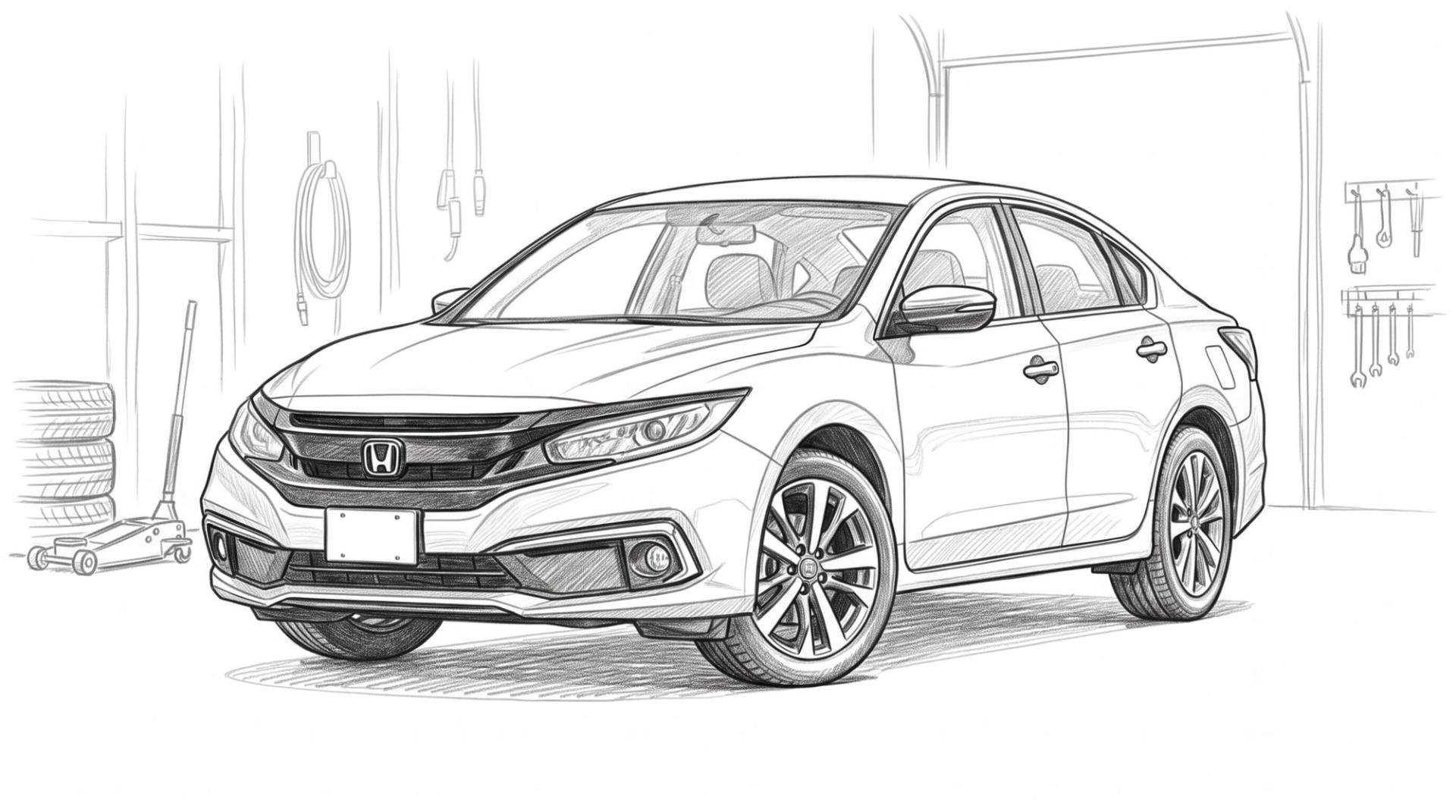
P0300 on a 2016-2018 Honda Civic 1.5L turbo means the PCM has caught misfires in more than one cylinder. Read every stored code, then check Honda's oil dilution and software path, since fuel-diluted oil and spark plugs top the list. A flashing check engine light is urgent, because the misfire can damage the catalytic converter.
Safety first
Fuel is flammable and under pressure.
Keep fire away, relieve the pressure before opening a line, and pull the 12 volt negative terminal before unplugging nearby connectors.
What does P0300 mean on a 2016-2018 Civic?
P0300 (Random Misfire Detected) means the PCM has seen misfires in more than one cylinder. It is not tied to one sensor or circuit.
The PCM follows crank speed through the crankshaft position (CKP) sensor pulses. When a cylinder loses combustion, crank speed drops sharply and the PCM counts it against that cylinder. Two kinds of misfire are watched:
- Severe (catalyst-damaging): 17 to 89 per 200 crankshaft revolutions, depending on engine speed and load.
- Light (emissions): 77 per 1,000 revolutions.
The monitor runs continuously between 480 rpm and 6,500 rpm, with manifold pressure above a speed-dependent minimum and fuel cut not active. If coolant is 14 F (-10 C) or colder at start, it waits until coolant reaches 68 F (20 C).
Detection takes two drive cycles. A severe misfire blinks the light once per second, stores a pending code and cuts fuel to the worst cylinder at high rpm until the drive ends. A repeat confirms the code, and from the third drive cycle the light stays on and blinks again on any severe misfire. A light misfire stores a pending code with the light off, and a repeat turns it on. Three clean drive cycles turn the light off. A pending code is erased after one drive with no misfire under the same conditions, or after 80 drive cycles with no misfire. P0300 stores when more than one of P0301 to P0304 is stored, and all four share these thresholds.
What symptoms does P0300 cause on the Civic?
- Check engine light steady, or flashing during a catalyst-damaging misfire
- Lack of power, rough idle, hesitation, rough cold start
- A whirling noise from the engine on some 2016-2018 cars
What causes P0300 on the Civic, most likely first?
| Rank | Cause | Quick confirm | Typical fix |
|---|---|---|---|
| 1 | Oil diluted with fuel, PGM-FI and TCM software not current | VIN eligibility, software status, oil smell | Honda's oil and software path |
| 2 | Worn or fouled spark plugs | Inspect the plug | Replace it (22 N-m); on Honda's path, only if fouled |
| 3 | Ignition coil fault, or oil in the coil and plug tube | Spark test; swap coils | Replace the coil; if oiled, clean it and replace the plug tube seals |
| 4 | Fuel injector fault or contaminated fuel | Swap injectors; inspect the fuel | Replace all injectors as a set; bad fuel gets a new filter and refill |
| 5 | Incorrect valve clearance or worn camshaft lobes | MAP fluctuates at idle; whirling noise | Adjust valve clearance with coolant below 100 F (38 C); worn lobes follow Honda's camshaft procedure |
| 6 | Exhaust restriction | MAP near atmospheric at 3,500 rpm | Check the catalyst; repair the exhaust |
| 7 | Carbon deposits, low compression or cylinder leakage | Compression and leakage tests | Top engine carbon cleaning; engine repair as tests require |
How do you diagnose P0300 on a 2016-2018 Civic?
You need a scan tool with misfire counters and a saved snapshot, a spark tester, and compression and leakage testers. Honda's software and relearn steps are shop or dealer work.
- 1
Read every stored code.
Fix these first if stored with the misfire codes, and check those systems by hand, since parts can fail without setting a code:
- fuel rail pressure P0087 and P0088
- high pressure fuel pump P2623
- MAF sensor P006A, P0102 and P0103
- MAP sensor P0107 and P0108
- fuel system P0171, P0172 and P2187
- CKP sensor P0335 and P0339
- CMP sensor A P0340 and P0344
- ignition coils P0351 to P0354
- idle control P0506 and P0507
- 2
Run Honda's oil and software path next.
(only where the VIN is eligible)
- Reset the maintenance minder main code A, then drain and refill the oil with 3.4 US quarts, filter left alone.
- Check the A/C control unit status with Honda's software. Completed or Not Applicable means leave it; Not Complete means Honda's update bulletin applies: the software is updated and the control unit is replaced under the warranty extension. That extension runs 6 years from the original sale date with no mileage limit, so it has ended on most cars; the software update can still be covered by the emissions warranty (8 years or 80,000 miles, whichever comes first). Confirm your VIN status with a Honda dealer.
- Update the PGM-FI and TCM software only if it is not current. After an update, reset the throttle position learned values and run the PCM idle learn.
- If the misfire codes return, inspect the plugs. Fine plugs end Honda's procedure and normal troubleshooting carries on. Replace fouled plugs only; if the codes return after new plugs, Honda's procedure does not apply.
- For a whirling noise that matches Honda's reference sound, pull the cylinder head cover and compare the camshaft lobes to Honda's reference photos. Replace the camshafts and rocker arm assemblies only if the lobes look like the damaged example, then repeat the steps above; otherwise Honda's procedure does not apply.
- 3
Verify the misfire.
Watch the per-cylinder counters at idle: one cylinder or several, and a count that rises every revolution or every few (a partial misfire). If idle is clean, hold 3,500 rpm and watch again. If neither shows it, open the saved snapshot, note the conditions where the count starts rising, and drive under them; a cold-only misfire goes to the cold branch. If it will not repeat, poor fuel may have caused it.
- 4
Work the branch that matches.
- One cylinder:
- Inspect that plug; replace it if it shows failure or is the wrong part.
- Spark test the coil. With no spark, swap it with a good cylinder's and retest; a coil that moves the problem is bad. If the circuit is at fault, check coil power, ground, control wires and the PCM.
- Check the coil and plug tube for oil; if oiled, clean them and replace the plug tube seals.
- Swap plug and coil with a good cylinder's and see if the misfire follows.
- If it stays, run compression and leakage tests (low compression with normal leakage means incorrect camshaft timing, a bent connecting rod or worn lobes), then swap the injector. If the misfire follows it, replace all injectors as a set; if not, clear and relearn the CKP pattern.
- On a partial misfire, check the MAP signal at idle first; if it fluctuates, adjust valve clearance before the compression, leakage and injector steps.
- Several cylinders:
- Inspect the plugs. If the MAP signal fluctuates at idle, adjust valve clearance (coolant below 100 F (38 C) first), then run compression and leakage tests. Air escaping mostly from the exhaust or throttle body points to tight valve clearance.
- Check fuel pressure under the conditions the misfire showed up; if out of range, check for pinched or damaged lines, then replace the fuel tank unit. Diesel, water, rust or debris in the fuel means a new fuel filter and a refill.
- Check the MAF reading hot, in P or N, loads off. Out of range, replace the MAF and IAT sensor 1; in range, replace all injectors as a set.
- MAP near atmospheric at 3,500 rpm means an exhaust restriction, so check the catalyst for damage and repair it.
- Run the injector leak-down check and replace all injectors as a set if they leak. Then do a top engine carbon cleaning; if the misfire stays, replace all injectors as a set.
- Cold only: start with the MAP fluctuation check, then injector leak-down, plugs and the carbon cleaning. If it stays, replace all injectors as a set.
- One cylinder:
- 5
Make the repair.
Put a small amount of anti-seize on the plug threads, thread them in finger tight, then torque to spec. Reset the maintenance minder after an oil service.
Get the P0300 misfire tests for your Civic
The stored-code checks, misfire counter readings, plug and coil tests above follow Honda's own order. Ask emanuals.ai about your Civic 1.5T and get the test steps, specs and relearn procedures from the factory manual.
Specs you need for the Civic P0300 repair
| Spark plug torque | 22 N-m (2.2 kgf-m, 16 lbf-ft) |
|---|---|
| Oil drain bolt torque, new washer | 40 N-m (4.1 kgf-m, 30 lbf-ft) |
| Oil type | Honda Motor Oil 0W-20, API certified |
| Oil capacity, filter not replaced | 3.2 L (3.4 US qt) |
What if the obvious fix does not work?
If new plugs did not cure it on Honda's path, Honda's procedure no longer applies. Go back to the branch that matches your counters. The stop point: if the misfire stays with the cylinder after the injector swap and CKP relearn, check for authorized service information or substitute a known-good PCM.
How do you confirm the repair?
Clear the codes with the scan tool, then do the relearns. The crank pattern clear and relearn is required after replacing the CKP sensor or clearing the pattern in diagnosis; the PCM idle learn is required after the PCM is replaced, reset or updated, the throttle body is replaced or cleaned, or the engine or transmission is taken apart.
Then run this drive pattern where traffic rules allow:
- Hold 3,000 rpm with no load (CVT in P or N) until the radiator fan comes on.
- Drive on a flat road between 15 mph and 75 mph for at least 3 minutes.
- Stop and idle for at least 3 minutes.
- If freeze data was stored, drive under those conditions instead of the second and third parts. Repeat if the conditions are hard to reproduce.
Watch the per-cylinder misfire counters while you drive. The repair held if they do not rise.
Questions mechanics ask about P0300 on the Civic
What does P0300 mean on a 2016-2018 Honda Civic 1.5T?+–
P0300 means the PCM has found misfires in more than one cylinder through the crankshaft position signal and has stored more than one of P0301 to P0304 with it. There is no single sensor behind P0300, so you diagnose the misfire, not a circuit.
Can you drive with a P0300 code?+–
Not if the P0300 comes with a flashing check engine light. A flashing light means the misfire is at a level that can damage the catalytic converter, and the PCM also cuts fuel at high rpm to the cylinder with the most misfires, so treat it as urgent and get it diagnosed before driving further.
A steady light means the misfire is affecting emissions but has not reached that level, so it is less urgent, but it still needs diagnosing. Some of these cars also lose power depending on driving behavior.
Will it clear itself?+–
It depends on whether the misfire stops. The P0300 light goes out by itself if the problem does not return in three consecutive drive cycles under similar conditions. A pending code is erased after one drive with no misfire under the same conditions, or after 80 drive cycles with no misfire.
If the cause is still there, the misfire and the code can come back. A scan tool clear or disconnecting the battery also clears it, but that does not fix the cause.
Is there a Honda bulletin for it?+–
Yes, for 2016-2018 Civics with the 1.5L, with eligibility confirmed by VIN. Product update bulletin 18-137 covers cars in a list of cold-weather states, and warranty extension bulletins 19-033 and 19-038 extend the powertrain warranty for the resulting camshaft, rocker arm and spark plug damage to 6 years from the original sale date, with no mileage limit. That window has ended for most 2016-2018 cars, so check your VIN status with a Honda dealer.
The bulletins pair an oil drain and refill, filter left alone, with a software update only if the software is not current and an A/C control unit step only if its status reads Not Complete. Honda ties it to oil dilution from control unit software thresholds, which can cause lack of power and these misfire codes.
Sources
- Honda Civic Service & Repair Manual, section DTC Troubleshooting, P0300 to P0304 (1.5L turbo engine)OEM Manual
- Honda, TSB 18-137, "Product Update: 2016-18 Civic: Software and A/C Control Unit Update; DTC P0300, P0301, P0302, P0303, P0304, or P0172", 2016-2018, March 5, 2019Service Bulletin
- Honda, TSB 19-033, "Warranty Extension: 2016-18 Civic 1.5L: Software Update with A/C Control Unit Replacement; DTC P0300, P0301, P0302, P0303, P0304, or P0172; Whirling Noise from Engine", 2016-2018, January 11, 2023Service Bulletin
- Honda, TSB 19-038, "Warranty Extension: 2016-18 Civic 1.5L: DTC P0300, P0301, P0302, P0303, P0304, or P0172; Whirling Noise from Engine", 2016-2018, June 18, 2019Service Bulletin
- Honda, Campaign 6DV, "Product Update: 2016-18 Civic: Vehicle and A/C Control Unit Update", 2016-2018, May 2019Owner Notice
- Honda, Campaign D4D, "Warranty Extension: 2016-18 Civic 1.5L: Software Update with A/C Control Unit Replacement; DTC P0300, P0301, P0302, P0303, P0304, or P0172; Whirling Noise from Engine", 2016-2018, July 2019Owner Notice
- Honda, "2016-18 Civic and 2017-18 CR-V Engine Oil Dilution Drivability Concerns Warranty Extension", 2016-2018, April 5, 2019Dealer Memo
- emanuals.ai, Query data, "P0300 Honda Civic"First-Party Data

ASE Master Technician
JC spent 15+ years as a certified Master Mechanic before trading the shop for the keyboard. He's worked across dealerships, owned and operated his own independent garage, and consulted on automotive trade school curricula, reviewing technical textbooks used in vocational programs.
He now serves as Editor-in-Chief at emanuals.ai, where he oversees the platform's technical content. He's one of the few voices in automotive publishing who turned wrenches professionally for decades before he had a byline.
Keep going
Ask emanuals.ai about your car
Answers come from the actual factory manual for your make, model and year, with the page cited. Join the waitlist and we will email you when a spot opens up.
Invite-only beta. No spam, one email when your spot opens.