
P0420 on a 2014-2015 Subaru Forester 2.5L: Check the Exhaust for Leaks First
 JC Landry, ASE Master TechnicianPublished Oct 26, 2026 · Updated Oct 27, 2026
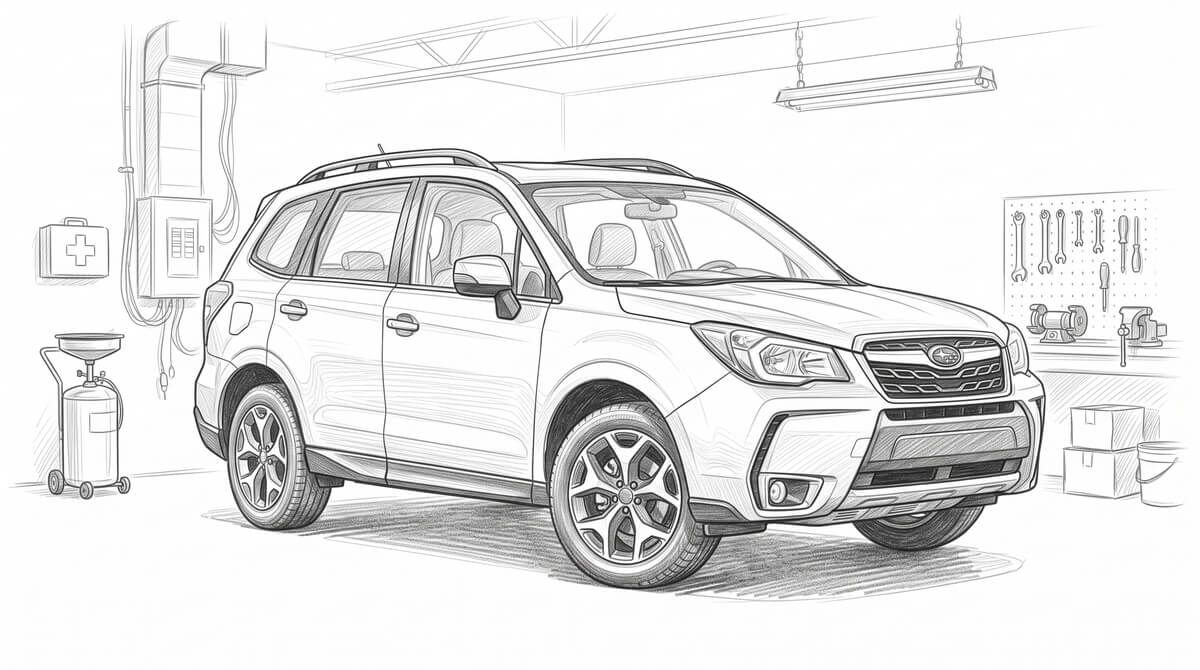
P0420 on a 2014-2015 Subaru Forester 2.5L (FB25) means the ECM judges that the front catalytic converter is not cleaning the exhaust well enough. Start with an exhaust leak near the converter or sensors, since that is the cheapest thing to rule out. Confirm by graphing the rear oxygen sensor against the front A/F sensor on a steady highway drive. If the engine runs rough or stalls, stop driving it and diagnose.
Safety first
- Exhaust parts stay extremely hot after driving; let the pipe cool before removing sensors or you can damage it.
- The front and center pipe assembly is very heavy, so do not drop it.
- Wipe spilled sensor lubricant or grease off the exhaust pipe, since it can smoke or catch fire.
- Disconnect the battery ground cable before unplugging sensor connectors.
What does P0420 mean on a 2014-2015 Forester?
P0420 (Catalyst System Efficiency Below Threshold, Bank 1) points at the front catalytic converter, which is built into the front exhaust pipe. The ECM judges it using the front A/F sensor upstream and the rear oxygen sensor downstream.
The ECM adds up how much the front A/F lambda value and the rear oxygen sensor voltage move, in 32 ms steps, four times per calculation, then divides the rear total by the front total. A healthy converter keeps the rear signal calm while the front moves. A worn one lets the rear follow the front, so the ratio climbs.
The ECM sets P0420 when the rear deviation sum divided by the front deviation sum is above 10 (above 8 on PZEV models), over a diagnosis time of 30 to 55 seconds. The check only runs when all of these hold:
- Battery voltage 10.9 V or more.
- Atmospheric pressure 75 kPa (22.2 inHg) or more.
- Coolant temperature 60 degrees C (140 degrees F) or more.
- Estimated catalyst temperature 535 degrees C (995 degrees F) or more, CVT and manual alike.
- Misfire count per 200 rotations below 65535.
- EVAP gas density learning value below 1.
- Sub feedback in operation.
- Evaporative system diagnosis not running.
- Time with actual lambda within 0.10 of target lambda 0 ms or more.
- Vehicle speed above 40 km/h (24.9 mph).
- Intake air amount 8 g/s (0.28 oz/s) or more and below 45 g/s (1.59 oz/s).
- Engine load change per 0.5 engine revolutions below 255 g/rev (8.99 oz/rev).
- Rear oxygen sensor output has crossed from 660 mV or less to 660 mV or more after a fuel cut.
- Elapsed time after start and purge execution time both 0 s or more.
The diagnosis runs once, at a constant 40 km/h (24.9 mph) or higher. The fault clears when the same ratio comes back at 10 or lower (8 or lower on PZEV) in a later check.
The fault is detected when two consecutive driving cycles show it, and the warning light comes on when the malfunction occurs in 2 continuous driving cycles.
Two groups of related codes matter here:
- Rear oxygen sensor codes: P0137 (low voltage, bank 1 sensor 2) sets with output below 0.03 V, and P0138 (high voltage) sets above 1.2 V. P0140, P013A, P013B, P013E and P013F cover the same sensor.
- Post catalyst fuel trim codes: P2096 (too lean, bank 1) sets with a sub feedback learning value below minus 0.042 on CVT or minus 0.044 on manual, non-PZEV. P2097 (too rich) sets at 0.013 or more on CVT or 0.017 or more on manual, non-PZEV.
What symptoms does P0420 cause on the Forester?
- Check engine light on.
- Engine stalls.
- Idle mixture out of specification.
- You may notice reduced fuel economy.
- You may notice a sulfur or rotten egg smell.
- You may hear a rattle from the exhaust.
- A failed emissions test.
What causes P0420 on the Forester, most likely first?
Here is how I would rank the causes.
| Rank | Cause | Quick confirm | Typical fix |
|---|---|---|---|
| 1 | Exhaust leak or loose joint or sensor | Check the exhaust joints and sensor seating | Replace the gasket, retighten to torque, reseat the sensor |
| 2 | Worn or damaged front catalytic converter | Rear trace swings with the front on the 50 to 70 mph graph; visible damage | Replace the front pipe with its built-in converter, new gaskets |
| 3 | Failing rear oxygen sensor | Every other check in the diagnosis is clear | Replace the rear oxygen sensor |
| 4 | Water or a wiring fault at the rear sensor connector or harness | Noise on the rear trace at idle; water in the connector | Remove the water, repair the connector or wiring |
| 5 | Engine oil use | Oil level dropping, white smoke at the muffler | Repair the engine, then replace the front converter |
| 6 | Ignition fault | Spark plugs, coil connector and plug terminal condition | Repair, then replace the front converter |
| 7 | Fuel or intake fault | Fuel system, throttle body, intake manifold | Repair, then replace the front converter |
Subaru issued service bulletin 02-157-14 on engine oil consumption for 2.5L FB engines in listed VIN ranges, including the 2014 Forester and the 2015 Forester with a manual transmission. That lines up with cause number 5, engine oil use.
How do you diagnose P0420 on a 2014-2015 Forester?
You will need a scan tool that graphs live data, basic hand tools, a torque wrench, spray lubricant, anti-seize and new exhaust gaskets.
- 1
Check the exhaust for leaks and loose hardware.
Look at the joints from the cylinder head to the front pipe, the front pipe to the front catalytic converter, and the front converter to the rear converter. Make sure the front A/F sensor and the rear oxygen sensor are seated and tight. A leak can fool the sensors and cost you a converter you did not need. If you find a fault, repair or replace that exhaust part. If everything is tight, move on.
- 2
Graph the rear oxygen sensor voltage and the front A/F lambda together.
Drive at a steady 80 to 112 km/h (50 to 70 mph) and read the graph after 5 minutes. A steady rear trace is normal. A rear trace swinging up and down many times is abnormal. If the graph is normal even though the code is set, the fault is not present right now; reproduce the failure and diagnose again, since a temporary connector or harness problem can be behind it. If abnormal, move on.
- 3
Repeat the graph at idle.
If the trace looks normal, or the rear trace swings many times, move on to the converter check. If the rear trace is noisy, skip ahead to the connector and wiring check.
- 4
Check whether the front catalytic converter is damaged.
If it is, replace it. It is part of the front exhaust pipe, and the front and center pipes come out together. If not, move on.
- 5
Check the rear oxygen sensor connector and its coupling connector for water, and remove any you find.
Then check the wiring between the ECM and the rear oxygen sensor, and the sensor shield, for an open circuit or poor contact. Repair what you find. If it is clear, move on.
- 6
Work through engine, ignition, fuel and other codes, in this order:
- Engine oil level dropping or white smoke from the muffler: repair the engine, replace the front catalytic converter, then repeat the highway graph and finish.
- A fault in the ignition system (spark plugs, ignition coil connector and spark plug terminal condition): repair it, replace the front catalytic converter, then repeat the highway graph and finish.
- A fault in the fuel system, throttle body or intake manifold: repair it, replace the front catalytic converter, then repeat the highway graph and finish.
- Any other code displayed: check that code, replace the front catalytic converter, then repeat the highway graph and finish.
- None of the above: replace the rear oxygen sensor.
Get the P0420 tests for your Forester
The exhaust leak check, sensor graphs and converter checks above follow Subaru's own test order. Ask emanuals.ai about your Forester 2.5L and get the exact test steps, specs and procedures from the factory manual.
Specs you need for the Forester P0420 repair
| Front exhaust pipe nuts at the cylinder heads | 30 N·m (22.1 ft-lb); new gasket |
|---|---|
| Center exhaust pipe to front exhaust pipe | 35 N·m (25.8 ft-lb); new gasket |
| Center exhaust pipe to rear exhaust pipe bolts and nuts | 18 N·m (13.3 ft-lb); new gasket |
| Center exhaust pipe hanger bracket bolt | 35 N·m (25.8 ft-lb) |
| Front exhaust pipe heat cover bolts (when moving the covers to a new pipe) | 13 N·m (9.6 ft-lb) |
| Front oxygen (A/F) sensor | 21 N·m (15.5 ft-lb) |
| Rear oxygen sensor | 21 N·m (15.5 ft-lb) |
Snug the head nuts first, fit the center to rear pipe bolts and the hanger bolt, then tighten the head nuts to torque. Spray lubricant on a sensor thread and wait a minute or more before removing it. Anti-seize goes on sensor threads only, never on the protector.
What if the obvious fix does not work?
Ask whether the converter was ever the real problem. Replacing it before the cheaper checks is a common mistake, and so is replacing only the sensors when the converter has failed. Rule out leaks near the sensors first, including intake or vacuum leaks, though the code can return after a leak repair if the converter is the cause.
An aging or contaminated rear oxygen sensor can make a healthy converter look bad. If you replace it, an OEM or OEM supplier sensor is the safer choice, since cheaper ones are a possible source of repeat codes. Spacers or other tricks that change what the sensors read hide the code without repairing anything.
If the oil level keeps dropping or you see white smoke at the muffler, stop the converter work. The engine repair comes first, then the front converter.
How do you confirm the repair?
Clearing memory with the scan tool after the repair is required. Wait 10 seconds or more with the ignition ON before starting the engine, and clear memory again after reconnecting any sensor connector. Check any other stored code before you replace the converter, and record the codes before repairing.
Inspection mode does not test P0420, so use the drive cycle instead:
- Battery at 12 V or more, and fuel about half full (20 to 40 L, 5.3 to 10.6 US gal).
- Clear memory and confirm no code remains.
- Warm the engine.
- Drive 20 minutes or more at a constant 80 km/h (50 mph) or more.
- Stop and idle for one minute.
- Read the temporary code with the scan tool.
Then repeat the highway graph and confirm the rear trace is back to normal.
Questions mechanics ask about P0420 on the Forester
Can you drive a 2014-2015 Forester 2.5L with P0420?+–
A rough or stalling engine is a reason to stop and diagnose. Engine stalling and an off-idle mixture are the trouble symptoms tied to this code. You may find the car drives normally with the light on, but that does not mean the cause can wait forever.
Will P0420 clear itself on the Forester?+–
It can. The ECM clears the fault when a later check passes, with the ratio at 10 or lower, and that check runs only with the engine warm and above 40 km/h (24.9 mph). The light can also go out after highway driving and then come back before it stays on.
Does Subaru's warranty extension cover P0420 on the Forester?+–
The extension was for engine oil consumption, and its window has run out for these model years. Subaru's extension covered the powertrain warranty on 2.5L FB engines for excessive oil consumption, out to 8 years or 100,000 miles from the original warranty start date, with a short block replacement for confirmed cases (2015 Forester with a manual transmission only). What it still tells you is that Subaru found oil use on this engine, which is why I check the oil level before buying a converter.
Is P0420 always the converter on a 2014-2015 Forester?+–
No. The front converter gets replaced when it is damaged or after an engine, ignition, fuel or other code repair. When nothing else turns up, the rear oxygen sensor gets replaced. The converter is built into the front exhaust pipe, so the front and center pipes come out together and the sensors move to the new pipe.
Do I need to clear codes and drive after the repair?+–
Yes. Clear memory, wait 10 seconds with the ignition ON, then run the drive cycle: 20 minutes or more at a steady 50 mph or more, stop and idle one minute, then read the temporary code. The converter check only runs warm and above 40 km/h (24.9 mph).
Sources
- Subaru Forester Service & Repair Manual, sections Engine (Diagnostics), Exhaust and Fuel Injection (2.5L FB25).OEM Manual
- Subaru service bulletin 02-157-14, "Engine Oil Consumption", 03/06/18.Service Bulletin
- emanuals.ai, Query data, "P0420 Subaru Forester".First-Party Data

ASE Master Technician
JC spent 15+ years as a certified Master Mechanic before trading the shop for the keyboard. He's worked across dealerships, owned and operated his own independent garage, and consulted on automotive trade school curricula, reviewing technical textbooks used in vocational programs.
He now serves as Editor-in-Chief at emanuals.ai, where he oversees the platform's technical content. He's one of the few voices in automotive publishing who turned wrenches professionally for decades before he had a byline.
Ask emanuals.ai about your car
Answers come from the actual factory manual for your make, model and year, with the page cited. Join the waitlist and we will email you when a spot opens up.
Invite-only beta. No spam, one email when your spot opens.